
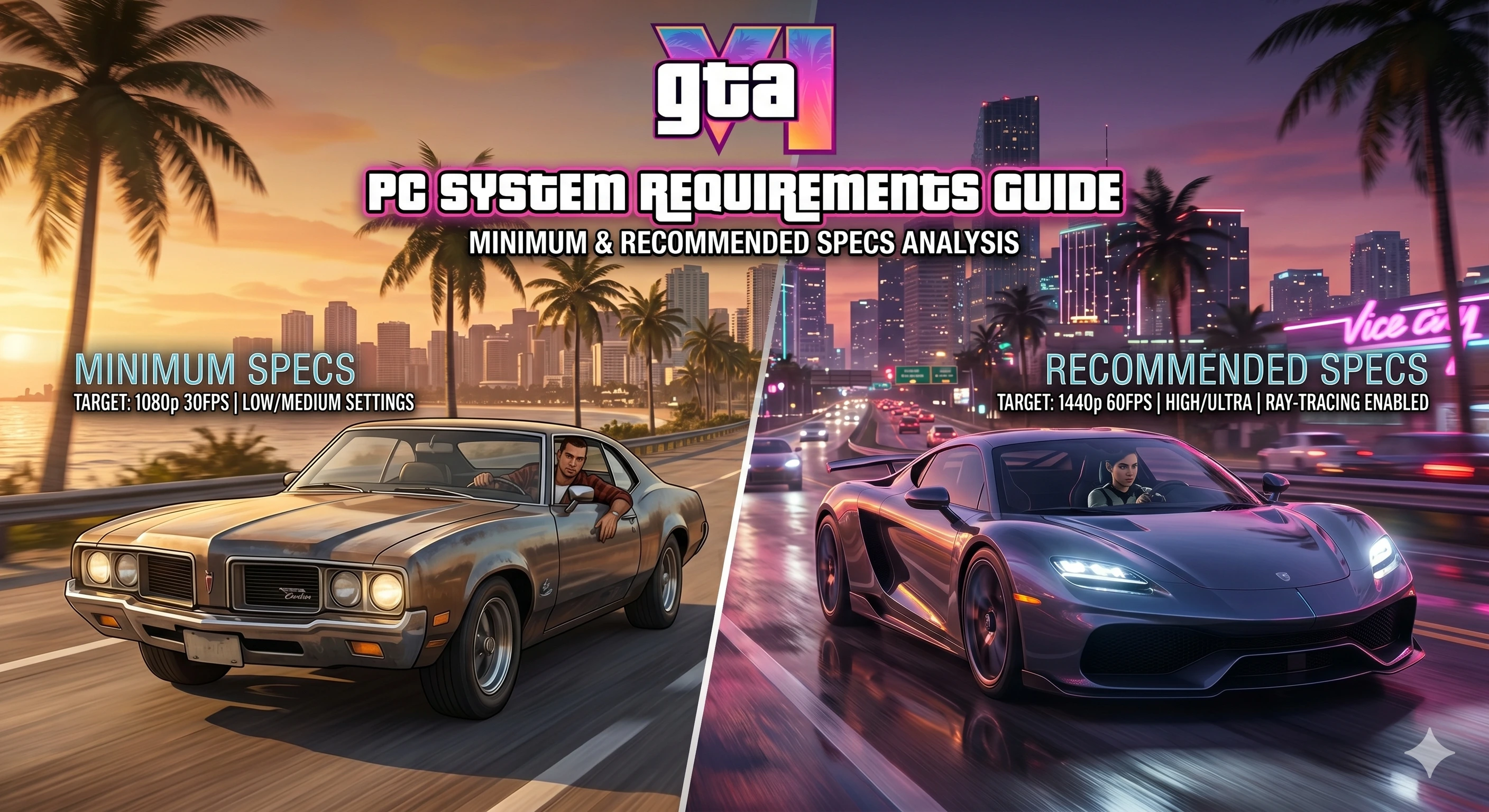
GTA 6 PC system requirements — minimum and recommended
Rockstar has not published official PC system requirements for Grand Theft Auto VI. The console version launches November 19, 2026 on PS5 and Xbox Series X|S, and — following the pattern of GTA V and Red Dead Redemption 2 — the PC port is expected roughly 12–18 months later, in late 2027 or early 2028.
So everything below is a forecast. We built it by reverse-engineering the PS5 / Xbox Series X hardware baseline, the demands of Rockstar's new RAGE 9 engine, and the technologies Rockstar quietly shipped into the GTA V Enhanced PC edition as a live testbed. Treat these as informed estimates to plan an upgrade around — not as a spec sheet.
The quick glance
Storage
150 GB+
NVMe SSD required
Recommended RAM
32 GB
16 GB minimum · DDR5 preferred
Target VRAM
12 GB
6–8 GB bare minimum
Minimum specs (predicted)
The minimum tier is the lowest realistic barrier to entry: roughly 1080p, 30 FPS, Low–Medium settings, leaning hard on upscaling, with ray tracing largely disabled or running at its lowest quality. Expect frame dips during heavily simulated moments like busy intersections or storms.
Minimum
1080p · 30 FPS · Low- OS
- Windows 10 64-bit
- CPU
- Intel Core i5-10600K / i5-10400F
or AMD Ryzen 5 3600 - GPU
- NVIDIA GTX 1660 Super (6 GB)
or AMD RX 5600 XT - RAM
- 16 GB
- Storage
- 150 GB NVMe SSD
- DirectX
- 12 Ultimate
The binding constraint at this tier is the CPU. A Ryzen 5 3600 roughly matches the eight Zen 2 cores inside the PS5 and Xbox Series X, so a six-core chip is the realistic floor — RAGE 9 spreads NPC AI, traffic pathfinding, and deterministic physics across many threads, and older quad-cores will stutter badly. The 6 GB GPUs listed lack dedicated ray-tracing hardware, so minimum-spec players will run rasterized fallback lighting and reduced texture resolution to stay inside the VRAM budget.
Recommended specs (predicted)
The recommended tier targets an experience that beats the base consoles: roughly 1440p, 60 FPS, High settings with Ray-Traced Global Illumination enabled, using DLSS / FSR upscaling and frame generation where supported.
Recommended
1440p · 60 FPS · High- OS
- Windows 11 64-bit
- CPU
- Intel Core i7-12700K / Core i5-14600K
or AMD Ryzen 7 5800X3D / Ryzen 7 7700X - GPU
- NVIDIA RTX 4070 / RTX 5070 (12 GB)
or AMD RX 7800 XT / RX 9070 XT - RAM
- 32 GB (DDR5 preferred)
- Storage
- 150–200 GB Gen 4 NVMe SSD
- DirectX
- 12 Ultimate
This is the value sweet spot. The jump from six to eight high-IPC cores — ideally with large L3 cache like the Ryzen 7 5800X3D's 3D V-Cache — is what feeds the GPU fast enough for a smooth 60 FPS. A last-gen RTX 3080 or RX 6800 XT can also land here with frame generation, but stick to 12 GB or more of VRAM: 8 GB cards like the RTX 3070 tend to hit frame-pacing trouble once RT is on at 1440p.
Enthusiast specs (predicted)
The enthusiast tier is built for the hardware that will actually exist when the PC port lands in late 2027 or early 2028: native or near-native 4K, 60+ FPS, with every ray-tracing feature — potentially including full path tracing and ray-traced shadows — pushed to maximum.
Enthusiast
4K · 60+ FPS · Ultra / Path Tracing- OS
- Windows 11 64-bit
- CPU
- AMD Ryzen 7 9800X3D / Ryzen 9 9950X3D
or Intel Core i9-14900K / Core Ultra 9 285K - GPU
- NVIDIA RTX 5090 (32 GB) / RTX 5080
or RTX 4090 (24 GB) / AMD RX 7900 XTX - RAM
- 64 GB DDR5
- Storage
- 200 GB+ Gen 4 / Gen 5 NVMe SSD
- DirectX
- 12 Ultimate
At this tier the usual bottlenecks largely disappear. The RTX 5090's 32 GB of VRAM keeps uncompressed 4K textures and the full BVH ray-tracing data resident on the GPU, avoiding the slow page-back to system RAM over PCIe — and its Blackwell-generation DLSS 4 Multi Frame Generation is built exactly for path-traced workloads like GTA 6's. A cache-stacked CPU like the Ryzen 7 9800X3D — currently the fastest gaming chip available — bypasses the memory-bus stalls that choke simulation-heavy engines, keeping the GPU saturated with draw calls. And a Gen 5 NVMe drive — with theoretical throughput above 10 GB/s — makes load times functionally invisible and eliminates asset pop-in. Expect this build to lean heavily on DLSS Ray Reconstruction to denoise the RTGI signal for a clean, artifact-free 4K image.
Why GTA 6 is this demanding
Four architectural shifts drive the numbers above:
- RAGE 9 is simulation-first. Water is a physically simulated 3D volume (computed with Fast Fourier Transforms), weather actively changes vehicle handling, and NPCs run individualized logic. That work lives on the CPU, which is exactly why even the PS5 Pro — with only a ~10% CPU clock bump — is widely expected to stay locked at 30 FPS.
- Ray-Traced Global Illumination is baked in. All indirect lighting is ray-traced rather than baked, so RT can't be fully switched off without breaking the look. Building the BVH structures rays traverse is heavy on both CPU and VRAM.
- DirectStorage is mandatory, not a nicety. The engine streams assets straight from an NVMe SSD into GPU memory with hardware decompression, bypassing the old CPU-bound path. A mechanical hard drive (or even a SATA SSD) will cause traversal stutter and texture pop-in — which is why NVMe is a hard requirement and Windows 11 is strongly preferred.
- Strand-based hair and dense crowds push GPU compute and demand high-quality temporal upscaling (DLSS / FSR) to stay artifact-free.
The single biggest takeaway: don't pair a strong GPU with a weak CPU or a slow drive. The streaming-and-simulation architecture will stutter regardless of raw graphics horsepower.
Frequently asked questions
Are these the official GTA 6 PC requirements?
No. Rockstar has not released them. This is a research-based forecast, and we'll update it with the official specs once they're published.
When does GTA 6 come to PC?
There's no announced PC date. The consoles launch November 19, 2026; based on Rockstar's history (GTA V and RDR2 reached PC 18 and 12 months after their console debuts), a late-2027 to early-2028 PC release is the realistic window.
Will my PC run it?
If you're already at the recommended tier — an 8-core CPU, a 12 GB ray-tracing GPU, 32 GB of RAM, and an NVMe SSD — you're in great shape. On a six-core CPU with a 6 GB card, plan on 1080p with reduced settings and heavy upscaling.
Do I really need an SSD?
Yes. DirectStorage streaming makes an NVMe SSD a hard minimum. A hard drive will cause severe stuttering during fast travel, not just longer loading screens.
When the real codes and specs arrive, they'll show up here first — browse the GTA 6 cheats hub, watch the countdown, or read how to enter cheats in the meantime.
Sources & basis
This forecast synthesizes a deep-dive hardware analysis (RAGE 9 architecture, the ray-traced pipeline, DirectStorage, and tiered spec predictions) with these public anchors:
- Release date & platform strategy — Rockstar Games — Grand Theft Auto VI and Take-Two Interactive investor relations.
- Console CPU ceiling / 30 FPS analysis — Digital Foundry (Eurogamer) coverage of PS5 Pro hardware.
- DirectStorage on PC — Microsoft DirectX developer blog.
- PC hardware baseline — Steam Hardware & Software Survey.
- Technology testbed — Rockstar's GTA V Enhanced PC edition (RTGI, RT reflections, DLSS Ray Reconstruction, the SGA renderer backported from Red Dead Redemption 2).
Unofficial fan-made resource. Not affiliated with, endorsed, or sponsored by Rockstar Games or Take-Two Interactive. GTA and Grand Theft Auto are trademarks of their respective owners.